5 More Leftover Makeovers

You’ve seen my first list of leftover makeovers (right? Ok, here it is.) and here are five more. Yes, more! This is a more specific list of what I believe goes well in specific dishes.

  1. Frittata or quiche. One has a crust, one may not. Either way, chop your leftover veggies and (optional) proteins, throw into a pan with a little oil to heat then add a few eggs broken and whisked with a little milk. I realize some people prefer cream here, so do whatever works for you.
  2. Pizza. I have a friend who put all of her leftovers onto pizza. I can’t do it – corn, stir fry, rice, and potatoes just will not happen on a pizza for me. Barbecue chicken, though? Sure! Asparagus? Yes! Look at some local menus for inspiration. I’ve seen baked potato pizza as a very popular option. Would I make it at home? Probably not. This is where I found the idea to add ricotta cheese, feta, spinach, and ham to pizza…not together. Check out local menus online for quick ideas.
  3. Nachos. Yes! Who doesn’t love nachos? Ok, I know some people do not but many of us do including me! Chicken or beef, pulled meats, chili, corn, peppers, onions, various cheeses. It can all work on nachos. Have fun!
  4. Burrito Bowls. This is a favorite of mine. Works well with hot and cold items. Simply heat in your microwave in the order of building your bowl and you can make it work. I do rice first for say, 30 seconds, then corn, then a little cheese between corn and meat (heated at the same time), then add cold tomatoes or salsa or avocado or lettuce or all of the above.Whatever you have on hand! This is best for items without sauce on them or with a sauce that you would use in the bowl (barbecue or salsa for me).
  5. Baked potatoes. Now, potatoes have gotten a bad image over the last few years. I grew up loving potatoes and eating them often. A nice baked potatoes goes a long way with me toward comfort food- simply wash one up, poke a few holes in it and microwave for five or six minutes until it is soft. Remove from microwave and cut in half to allow it to cool and top with leftovers. My favorite toppings are broccoli and cheese, cheese and salsa or tomatoes, and pulled meats with cheese. I guess cheese and potatoes are the way to go with me!

What are your other leftover ideas? Let’s get creative!
A Frugal Person’s Best Friend

Your recipe box/app/notebook? Maybe. Your price book? Perhaps. Your car? Probably not. Your fridge? Could be. What this post will highlight is one of my favorites – the freezer!

Your freezer is a great place to store so many items. Yes, frozen foods which you purchase chopped, and already frozen but your freezer can hold so much more! Here are a few of my favorite items to stash in the freezer…

  1. Meat at sale price. This one rocks! Watch your favorite stores for your choice of meat and when it hits the sale price, that is the time to stock up. Buy whatever amount your freezer can store. I prefer to freeze meal size portions in gallon size bags. If you want to get fancy, throw a sauce in there to marinate the meat while it thaws.
  2. Local produce. Where I live we have amazing produce in the summer and I am sure that there are farms or farm stands near you which do the same. Although this may not be the best deal price-wise, it the best deal taste-wise. Very little beats a muffin made with local strawberries in January. 🙂 This goes for nearly anything local that you may be able to find. My favorites are local berries, peppers, and tomatoes.
  3. Meal shortcuts. This is one of my favorites which is often overlooked by others. Dried beans are a steal compared to canned, with the price per serving comparison at times is around 8 to 1. (An example being that the price per serving of canned beans is 24 cents as opposed to the price of dried beans at 3 cents.) Cook the beans on the stovetop or slow cooker, then freeze on a cookie sheet so they do not stick together. Once frozen, remove with a spatula and put into a freezer bag. The same goes for dried grains: cook and freeze flat then add to a freezer bag. The quick reheat on the stovetop for each is an amazing savings of time and money over par-boiled grains or canned beans. This also allows you to keep the amount of salt and seasonings to your preference or needs.
  4. Leftovers. When you only have one serving, or two, of a great soup left and do not want to use space in your fridge for it? Stash it in the freezer for the day when you would like soup but not taking the time to cook it. Now that’s a quick meal!
  5. Premade dinners. I did this when expecting my second child and it helped our family during the first few weeks when I didn’t have the time or energy to make dinner. And, I venture to guess that many of you have a night or two a week when you would rather not make dinner as well. (Takeout/delivery anyone?) Don’t order out, instead grab your premade dinner from the freezer. Honestly this is a big thing now. Check out the boards on Pinterest for ideas. Here is one site I like for freezer to crockpot dinners.

Any more ideas? Let me know! I’d love to see how you use your freezer to save.

Going Green and Frugal

Does this set of ideas seem to be at odds in your mind? How can one be green and frugal? It is possible and in my opinion, they are often one in the same. Most of us know the three Rs of Reduce Reuse Recycle (I hope).

What does it mean to go green? Aside from the choices in your purchases, this can also mean to use all of your resources in an economic fashion. Instead of buying new items which are made sustainably why not use your items until they are completely worn or cannot be repaired further? This is the less flashy, less “sexy” side of going green but I feel it may be the most useful….or at least the more frugal.

Imagine a few generations back in your family. What would your grandma, or great-grandma, do with her clothes? Many, though not all, who lived through the Great Depression would wear an item until it fell apart. Let us consider the spend-thriftiness of that generation, while knowing that not all were of the same mind…just as any society is never of one mindset. But I digress…

So, spent-thrift grandma would wear her clothes until they were holey. She might even mend them and continue to wear them with patches. She was reusing before it was cool. The ultimate hipster (Go, Gram!). There are other initiatives that were “older” which some of us still practice or could revive in order to go frugal green. Here’s a short list of ideas.

Start a garden. I have no green thumb. No, really. I have killed more than one cactus in my life. But…. this is a great starting point if you can grow your own. I have been able to keep a basil plant going for a summer and that saved several purchases of fresh basil. Start your own garden, taking into account the costs of supplies. The first year you may break even but on the second or third year you could be saving substantially.

Compost. This isn’t viable for everyone. Not everyone in an apartment can compost and I get that. In fact I have been an apartment dweller and did not compost. Once we had our own house and started composting it made a significant difference for us. The compost feeds the garden after one year, and it saves us on our community trash bags. We have to purchase specific bags for our town to use for trash disposal and they are expensive! However, this expense forces us to be more mindful of our waste and to cut down on it when we can.

Reuse. How often do you throw away milk cartons, either plastic or cardboard? Most families use milk like water. I know we consume a lot of milk. Reuse the cartons for starting seeds for your garden or for kids crafts. Many items can be reused before they need to be recycled. Just use common sense here – no sharp cans for toys, please!

Take reuse a step further. Go to your local thrift store or consignment shop. Bring in your items to be sold, if consigned then you will make a little back or receive a store credit. Bonus! If you simply shop there once your items need replacing then you are still reusing, just reusing the clothing of others. Another bonus is that most of the time your money spent stays local, and in the case of a Goodwill or Salvation Army store the money spent will help others in their programs.

Do not buy a new car. Hear me out on this one. This is along three lines of the first R: Reduce. If you keep your car for its lifetime of use then you are reducing the number of cars which you are contribute to a landfill in your lifetime. With proper maintenance you can (make it easier to) maintain your car for many years. When your car is done with its life, I suggest donating it to a charity in your area. Many will haul it away for free and recycle the parts or even just the materials in order to benefit their programs.

This is really just a start to how to go green in your own way. There are certainly many more ideas and many more topics to consider. My request to you is to consider all expenses before embarking on a new “green” endeavor. If the expense is worth it to you, then go for it! If you save a few dollars on the way, that is a bonus. Happy greening!


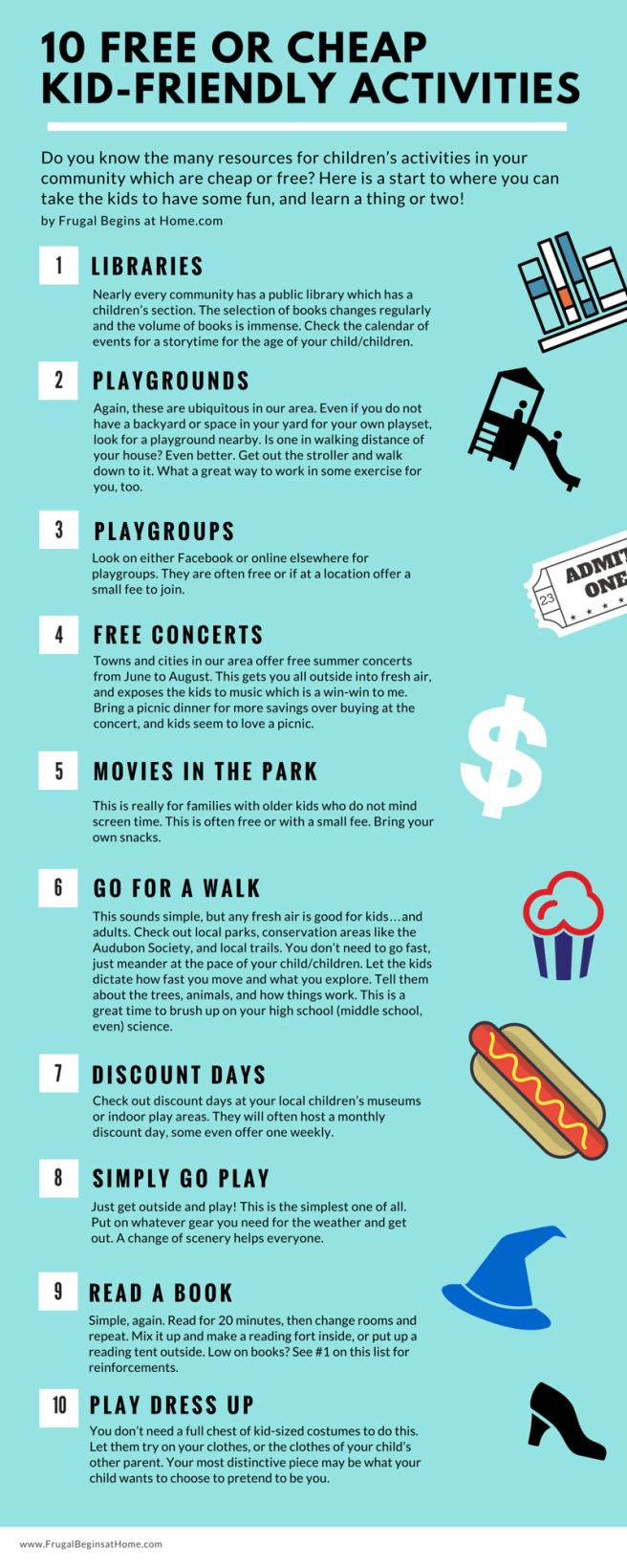
10 Free or Cheap Kid-friendly Activities

Do you know the many resources for children’s activities in your community which are cheap or free? Here is a start to where you can take the kids to have some fun, and learn a thing or two!

FBAH 10 Free or Cheap Activities

  1. Library. Nearly every community has a public library which has a children’s section. The selection of books changes regularly and the volume of books is immense. Check the calendar of events for a storytime for the age of your child/children.
  2. Playgrounds. Again, these are ubiquitous in our area. Even if you do not have a backyard or space in your yard for your own playset, look for a playground nearby. Is one in walking distance of your house? Even better. Get out the stroller and walk down to it. What a great way to work in some exercise for you, too.
  3. Play groups. Look on either Facebook or online elsewhere for playgroups. They are often free or if at a location offer a small fee to join.
  4. Free concerts. Towns and cities in our area offer free summer concerts from June to August. This gets you all outside into fresh air, and exposes the kids to music which is a win-win to me. Bring a picnic dinner for more savings over buying at the concert, and kids seem to love a picnic.
  5. Movies in the park. This is really for families with older kids who do not mind screen time. This is often free or with a small fee. Bring your own snacks.
  6. Go for a walk. This sounds simple, but any fresh air is good for kids…and adults. Check out local parks, conservation areas like the Audubon Society, and local trails. You don’t need to go fast, just meander at the pace of your child/children. Let the kids dictate how fast you move and what you explore. Tell them about the trees, animals, and how things work. This is a great time to brush up on your high school (middle school, even) science.
  7. Check out discount days at your local children’s museums or indoor play areas. They will often host a monthly discount day, some even offer one weekly.
  8. Just get outside and play. This is the simplest one of all. Put on whatever gear you need for the weather and get out. A change of scenery helps everyone.
  9. Read a book. Simple, again. Read for 20 minutes, then change rooms and repeat. Mix it up and make a reading fort inside, or put up a reading tent outside. Low on books? See #1 on this list for reinforcements.
  10. Play dress up. You don’t need a full chest of kid-sized costumes to do this. Let them try on your clothes, or the clothes of your child’s other parent. Your most distinctive piece may be what your child wants to choose to pretend to be you.

Imagination and time spent with children shows your love, and it does not need to be flashy or expensive. What are your favorite cheap or free activities to do with your kids?

Your Secret Weapon: A Pricebook

Have you heard of a pricebook? No? It is pretty simple and you can make it out of any notebook, maybe even with an app, and the best part is that it is completely customizable. This is one of your best frugal tools. And you can start one at any time. Here’s how.

  1. Get a notebook. Ideally this would be something that you can carry with you whenever you are out shopping. Would an app meet this need? Perhaps, most anyone who uses a smartphone tends to have it when in a store.
  2. Write down what you usually buy at the store. This works best with supplies that you pick up all of the time but look for the best price on. Meats, vegetables, grains, your kids’ favorite snacks, paper products. Anything that you buy on the regular.
  3. Add in the lowest price you typically see on this product. It may be $0.99 per pound, $2.99 per box, whatever it is and the unit sold (per pound, box including the ounces per box, et cetera). This is your guide.
  4. Compare this list to the local circulars in your area at the stores you usually shop.
  5. Compare this list to the local circulars in new stores that you do not usually shop.
  6. Bring the book with you to the store,  compare it to each item when you shop and you’ll start to get the feel for what is a good deal.
  7. Whenever anything is on sale, write down the date.
  8. Each week before you shop, browse the circulars for a deal and compare it to your list. You will start to see a pattern  of how frequently your items go on sale. This is when you stock up on items.
  9. Store your items properly for their containers (like, no boxes in the basement if water seeps into your basement). For ideas on how to use your freezer to stash items, check out this post.
  10. Once you have stocked up on a few items, you will start to get a good stash of items to use in your rotation of recipes. Notice the savings!

Take this a step further if you are feeling ambitious. Save your receipts to track your spending. Any tracking you can do here will help toward a better understanding of your spending habits.

Leftover Dinner Made Exciting

How often have you stared into the fridge, stacked with containers of leftovers while considering what to make for dinner? This was me last night….

It was a little of this and a little of that, most items nearly sauced or not sauced at all. Thankfully a few ideas came to me; quesadillas with leftover chicken and veggies, stuffed peppers with the aforementioned chicken and veggies plus some rice, and soup. I went with soup since I couldn’t be sure that the two little ones would eat stuffed peppers nor the quesadillas. Soup seemed to be the best option. With cornbread because they always eat cornbread. I used this recipe from Pinterest.

I added a few more items to the soup, started it with our last onion in a little oil, then chopped up three small zucchini and added half to the soup pot. The other half in sliced in the fridge for part of tonight’s dinner. A chopped leftover tomato, leftover diced tomatoes from a partially used can, leftover asparagus, three chicken thighs in a mild barbeque sauce,  four cups of water and some chicken bouillon cubes….and the soup is done! Ok, it did simmer for about a half hour after coming up to a boil. For a step-by-step on how I assemble soup, check out my Soup’s On! post.

The soup went over well, as did the cornbread. I’ll take that as a “win”. It is the little thins in life, right?

Soup’s On!

I touched on the topic of leftover soup in my 5 Ideas to Makeover Leftovers post and here is a more detailed explanation of how I approach leftover soup.

  • Assemble your leftovers and check to see their age. Always start with this. You don’t want to use items which are too old and potentially gone off.
  • Check for anything that may have a sauce or seasoning on it. If the items aren’t plain, then let the sauce/ seasoning be your guide to your base.
  • Decide on a base. Tomato sauce or canned tomatoes? If you have the time, you could start with fresh tomatoes. A stock or bouillon? Either of these two bases work well with a variety of leftover combinations. A cream-base is an option which I rarely use, that’s just my preference.
  • Chop all leftovers into similar size pieces. This helps them heat evenly and to all fit onto your soup spoon together.
  • Cook some onion in the pot with oil, garlic sometimes, too. I like them both and it depends on what mood I am in as well as what we have in the house. (No additional trips to the store during dinner time if I can avoid it!)
  • Add in each chopped leftover, either all together or one at a time. This is up to you, really, and how you build a soup. I add them in as they are ready – often chopping next to the stove top and dropping items in as each is ready.
  • Drop in some water, at least four cups but as many as eight depending on how much soup you want and how dense you like it.
  • Add in salt or bouillon. I tend to do one cube per cup of added water, less if the soup has a tomato base.
  • Bring to a boil, then simmer for up to a half hour to let the flavors meld.
  • Add a side of warm bread, freshly made or simply toasted bread.

Dinner is done! And, you have taken care of your leftovers. To me, this seems like a (nearly) free dinner since the items weren’t purchased simply to make this dinner. High five!

5 Ideas to Makeover Leftovers

Every week or two our fridge gets to the point that it seems full of leftovers. Half or even quarter-full containers of vegetables, grains and proteins take over the space which could be occupied by fresher items waiting for consumption. Some weeks we are diligent about eating leftovers for lunch the next day but some weeks we just miss that target for whatever reason. Sound like anything that you have experienced? Here’s a short list of what we have done with leftovers.

  1. Quesadillas. This is best for items which do not have some sauce on them or none at all, and depending on how many people you are feeding this is a great way to use little bits of leftovers mixed together. Best for: up to  3 or 4 items of approximately 1/2 cup in size.
  2. Sandwiches. Similar to quesadillas but better suited to those who have larger pieces of meat leftover. Say, thin sliced ham from a holiday dinner or roasted chicken. This is also an ideal way to take care of the last drips of bottled or jarred sauces like barbecue, pesto, or mayo. Best for: a few servings of sliced meat, sauces to finish.
  3. Stuffed Vegetables. This works well in the late summer when fresh zucchini or peppers are aplenty. I tend to do this if we have leftover rice, quinoa, or potatoes to add in. Best for: chopped or small proteins like chicken or beans, variety of veggies with no sauce or light sauce, if you have a grain to use.
  4. Pasta. Base a dinner around pasta works well for most combinations. How often have you perused a create-your-own pasta menu? Same idea. Cook pasta, saute veggies in your choice of oil to reheat then chop and add protein. Done! Best for: most veggie and protein combinations which have no seasoning/ sauce, very little, or with which you use more of that sauce.
  5. Soup. This is one of the easiest to accomplish. Decide on a base, chop all leftovers to spoonable size pieces, heat in a soup pot, then bring to a boil with some seasonings. most sauces used on leftovers tend to melt into the soup and add to the broth. Best for: variety of quantities of leftovers. Add a side like cornbread if it is missing from your leftover options.
  6. Ok. this is a bonus. Do leftover night! Some families love this night of the week since everyone can eat a dinner which differs slightly from others.

There you go! Here’s to a successful makeover on your leftovers. Waste not, want not…right?